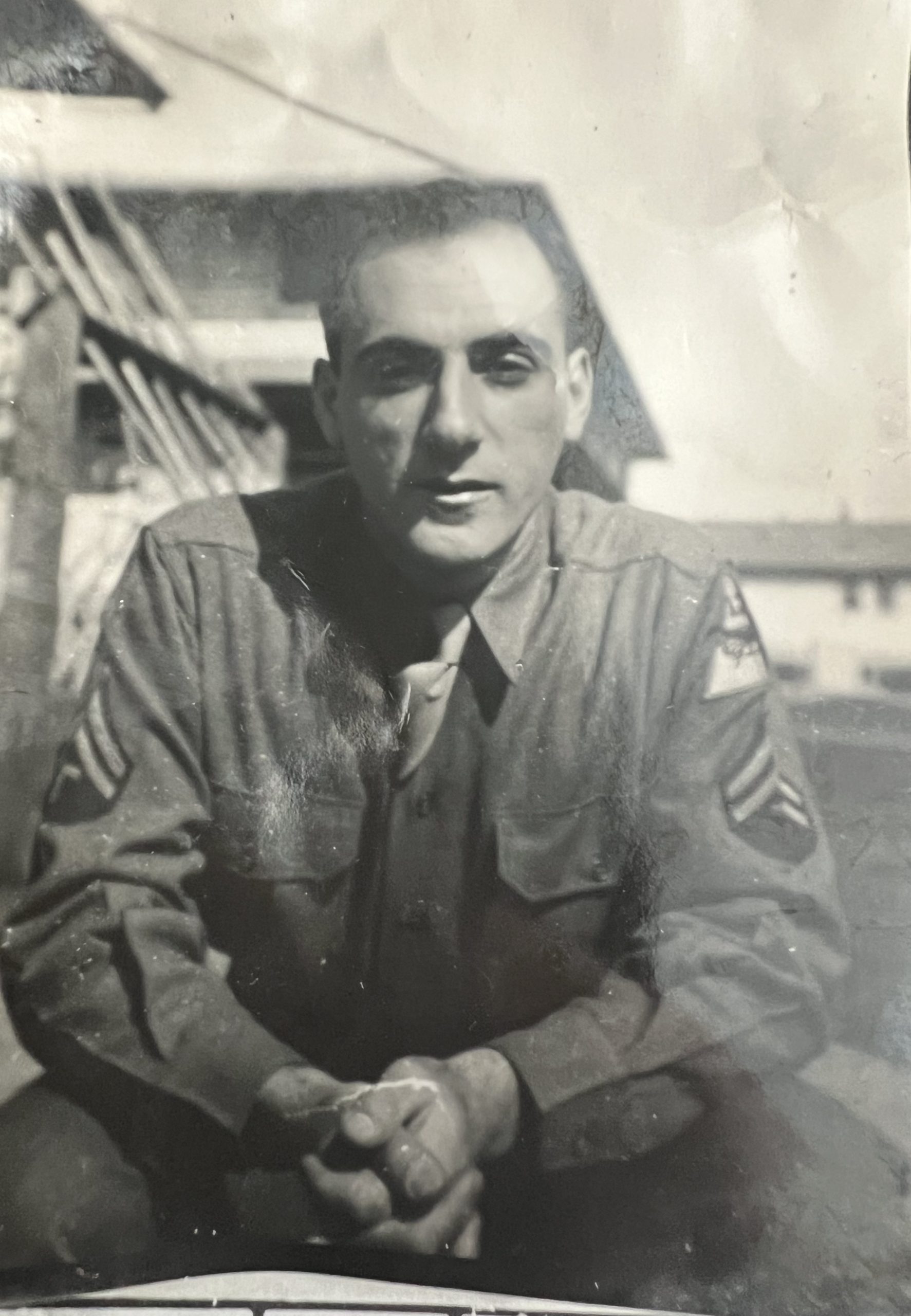
April 14, 1945 — U.S. Army Corporal Haig Derderian sat on a hillside with soldiers from his 714th Company B Tank Battalion in Unternesselbach, Germany.
It was about 5 pm on a warm spring day in this tiny German village about 50 miles west of Nuremberg. Men in the tank battalion had orders to stay there for the night. Nazi soldiers had strategically placed explosive mines in and around the area to thwart off the crushing United States Army.
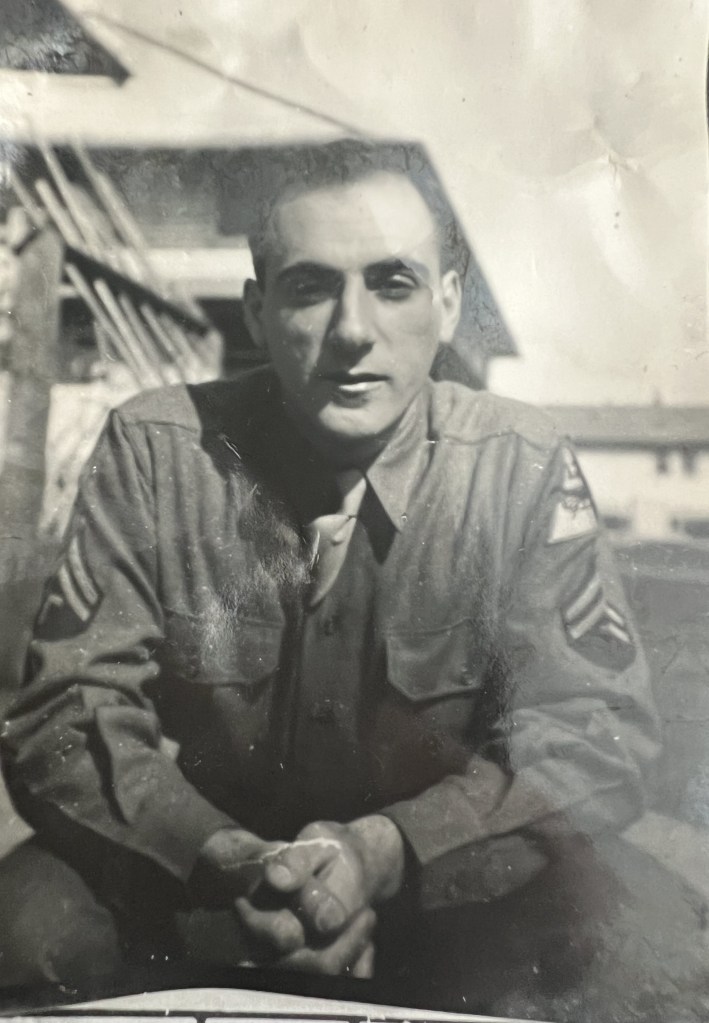
The previous 8 days, Haig and his battalion had cruised around almost a 100-mile radius blasting the enemy German Nazi Panzer and Tiger tanks and soldiers. The 714th Tank battalion was part of the U.S. Army’s feared 12th Armored Division (nicknamed the Hellcats) and it was on a roll through central Germany winning battle after battle.
Over the next three days, it would be a harrowing experience for Haig and his fellow soldiers, who would have to dodge land mines, enemy bullets being fired from deep within wooded areas, and mortars fired from German heavy combat vehicles.
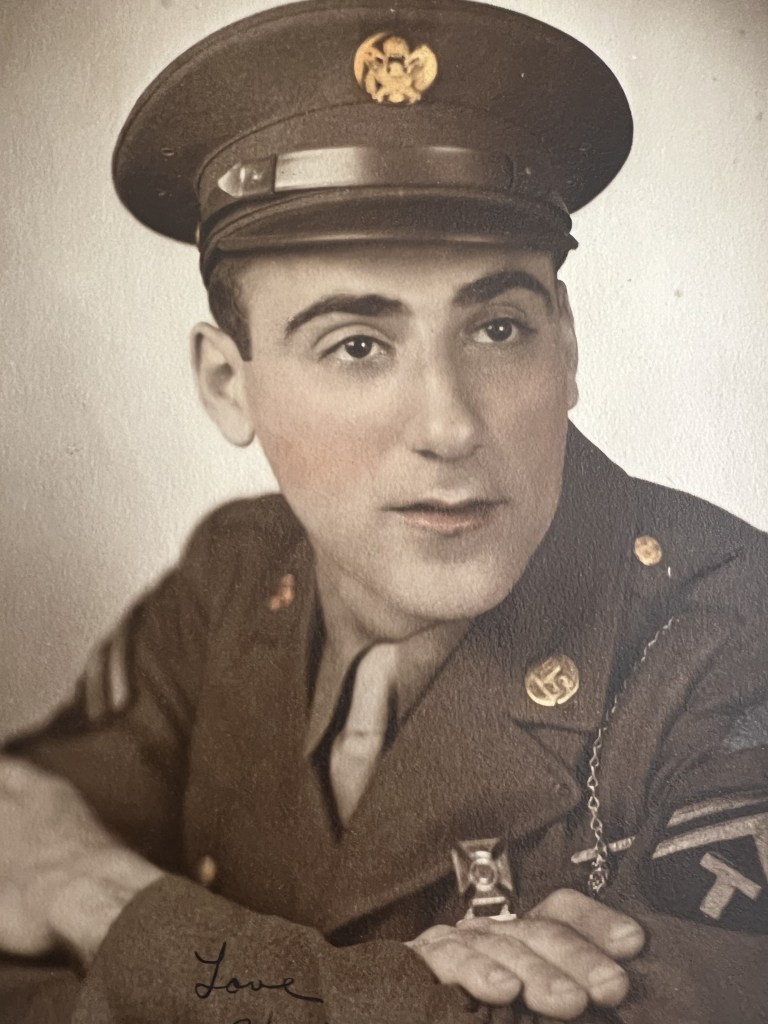
In three days, 27-year-old Haig Derderian from Woonsocket, R.I., would survive another brush with death in the uncertainties of a hellish world war and earn a Purple Heart, one of the most prestigious U.S. military medals ever awarded. I found his medal buried deep in a box in our basement last week.
The Purple Heart originally was called the Badge of Merit and was established by George Washington. It is awarded to U.S. soldiers wounded or killed in action. Over time, the award became known as the “Purple Heart” and — under its new name — was first awarded in 1932. Haig was one of 1,076,245 U.S. soldiers to receive the award during World War 2.
Why am I telling you about Haig Derderian? He’s the Father-in-Law whom I never met. You can read about him in a previous blog here.
This is the story of a man from Detroit who was born in 1917 to Armenian immigrants and a 72-hour period of his life and the lives of his unit between April 14th and April 17th, 1945 in Nazi Germany. These details come from the declassified 157-page After Action Reports documented by commanders of the 714th Tank Battalion and the 12th Armored Division. They are stored at the National Archives at College Park, MD. Other details come from letters that he sent from the war to his parents in Detroit in April 1945.
It was just another day in the war.
April 14th, 1945 — As Haig and his fellow soldiers in Company B of the 714th Tank Battalion sat on a hillside in Unternesselbach, Germany, their counterparts in D Company of the 714th Tank Battalion reached the town of Dietersheim about 3:15 pm. The town was flying a white surrender flag, and the only two bridges leading into town were intact. After crossing the first bridge, it was determined that the second bridge was too weak to sustain the weight of the 70,000-pound Sherman M-4 medium tanks.
Engineers from the company began fixing the bridge when German snipers in the surrounding heavily wooded area began firing on them. U.S. infantry machine gunners blanketed the area with bullets, killing many of the enemies. Two Nazi soldiers came out stumbling and carrying white flags to surrender. U.S. soldiers were able to fix the bridges, sweep up or safely detonate live mines, and continue their assault of retreating German troops.
At the same time in Unternesselbach, Haig and the rest of Company B heard a loud explosion. A medical jeep from the 56th Medical Detachment hit a land mine and injured two of the occupants. Haig and some of the soldiers went to assist the injured men and cared for them as they waited for other Army medics to arrive. Meanwhile, engineers from the 12th Armored Infantry continued clearing the area for mines despite sporadic mortar fire from Nazi soldiers.
A lieutenant in the command ordered his troops to fire mortars at a hill about a half mile away where U.S. forces observed German troops. Several mortars were lobbed at the hill and at 11 pm that night, the last of the enemy fire ceased. The Germans were likely dead.
Haig and the rest of his company went to sleep in makeshift barracks and closed their eyes to a silent, dark battlefield 4,261 miles from home.
A day of heavy enemy fire
April 15th, 1945 — Early the next morning at 5 am, the sound of heavy enemy vehicle movement interrupted the sleep of Company A and Haig’s Company B of the 714th Tank Battalion. The movement seemingly was right in front of them. Company C reported by radio that Nazi Panzer and Tiger tanks were in the vicinity to the southeast.
During these movements, two German soldiers walked out from a nearby brush, dropped their weapons and surrendered to Haig and his unit. Haig gently led one of the Nazi soldiers into the camp. The German soldier spoke in broken English and asked for a cigarette. Haig reached into his pocket and pulled out a pack of cigarettes. He used hand gestures to ask the German soldier if he’d like to trade for the entire pack, then mumbled under his breath, “You’re going to need these a lot more than I am, pal.”

The German solder yanked 2 silver chains off his neck that held bronze medals he had earned while fighting for the Nazis. He handed them to Haig. One was a Sudetenland Medal. The medal was awarded to all German state officials and members of the German Wehrmacht defense force and Schutzstaffel (SS) officers who entered the Sudetenland on Oct. 18, 1938. On the back of the medal is engraved the words, ”Ein Volk. Ein Reich. Ein Fuhrer.” The translation is One People, One State, One Leader. The other medal was the Medalia Cruciada împotriva comunismului , which was awarded to all Romanian and Axis soldiers (including Germans) who survived the 1941 “war against communism” battling Russia in World War 2.
The German soldier thanked Haig, pulled out a cigarette, lit one, gave it to Haig. Then he lit another and smoked it. They both took in a deep drag, exhaled, and smiled weakly. They greeted each other by shaking hands. Another U.S. soldier escorted the Nazi away and Haig looked on as this former German enemy and stranger walk away.

Haig and his company as well as Company C moved out from the area about 6:30 am toward the German town of Hermusneuses. About an hour later, the units received a considerable amount of fire from rifles in a densely wooded area. Around the same time, a half-track armored personnel carrier vehicle hit a mine and two U.S. soldiers from 56th Infantry were killed. The unit was sustaining heavy sniper and artillery fire from the Germans. A Lieutenant Cook in the division received a head wound and Company C’s Tank Battalion lost a rocket commander and first sergeant due to severe injuries.
Three hours later as Haig and his Army units continued moving toward Unterrossbach, they received reports that about 1,000 enemy troops were in the area. As the U.S. troops advanced, a few more U.S. armored vehicles were destroyed by mortars
As Haig and his entire company entered the town of Hermusneuses, they received intense artillery fire. It was now 4 pm and the unit was ordered to evacuate to the nearby town of Mosbach due to casualties and heavy fire. Mosbach was cleared out of any German troops and at 10 pm each of the companies in the 714th Tank Battalion were ordered to hunker down in Mosbach for the night and await orders.
More mines, more mortar fire
April 16th, 1945 — At 8 am, Haig and his unit prepared to move out of Mosbach. The company commander told his troops not to waste any time and get through the town as quickly as possible as they headed to the German town of Adeledorf. One big obstacle stood in the way: A main bridge heading into town had been blown up by the Nazis.
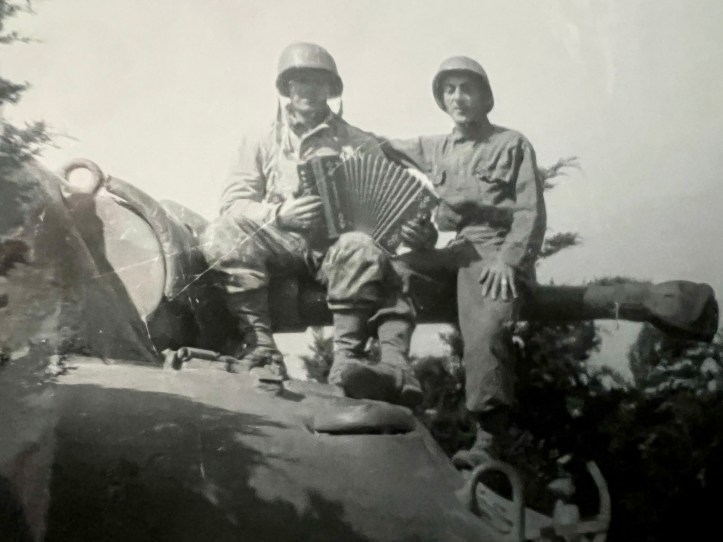
As Haig and his fellow soldiers attempted to repair the bridge, the unit received heavy air and ground fire at the rear of the company by the Germans. One U.S. Sherman tank was blown up in the process and several U.S. servicemen were injured by enemy fire. Haig and the troops repaired the bridge, allowing the unit to cross the river and head into the city.
As the unit traveled at a rapid pace at 6 pm between the cities of Ebernderf and Kircheimbach, the unit received heavy artillery fire from the Germans. U.S. Army reconnaissance spotted German machine gunners and destroyed them. Haig and his unit patrolled the area and found a German airplane and airfield as well as bombs, a huge stockpile of weapons, and ammunition in crates. They ended up destroying the airfield, planes, ammunition, and weapons.
At 11 pm, it was time to turn in for the night. Just another day at war.
Of all the days!
April 17th, 1945 — Haig enlisted in the U.S. Army in 1942. He had been through Army training until Sept. 20, 1944 on the mainland in the U.S., then was sent over to Europe where he landed Oct. 1st in the English port of Southampton. He then battled from December through April in France and Germany against the Nazis.
This day started like any other for him in the previous 4 months — Haig found a German Panzer tank hidden inside a vacant shed. The tank was unoccupied. The soldiers seemingly fled sometime during the night as the engine was still warm.
The troops now had advanced to the tiny village of Grosshabersdorf, about 35 miles from Nuremberg. Haig’s unit also located 2 other German tanks and armored vehicles and destroyed them with artillery from the Sherman tanks.
At around 1:30 pm, the troops discovered another minefield and began clearing it. Haig was one of the servicemen trying to sweep the mines so he and the units could pass.
Without warning, a mine exploded 20 yards from Haig. A piece of hot metal shrapnel flew through the air at blistering speed and caught Haig on the right arm. It torn into his flesh through his shirt and he began to bleed heavily. He went down to the ground and 3 fellow soldiers went to Haig’s aid. He was transported by a medic jeep 10 minutes away to a makeshift battlefield hospital. His battlefield injury would earn Haig Derderian a Purple Heart.
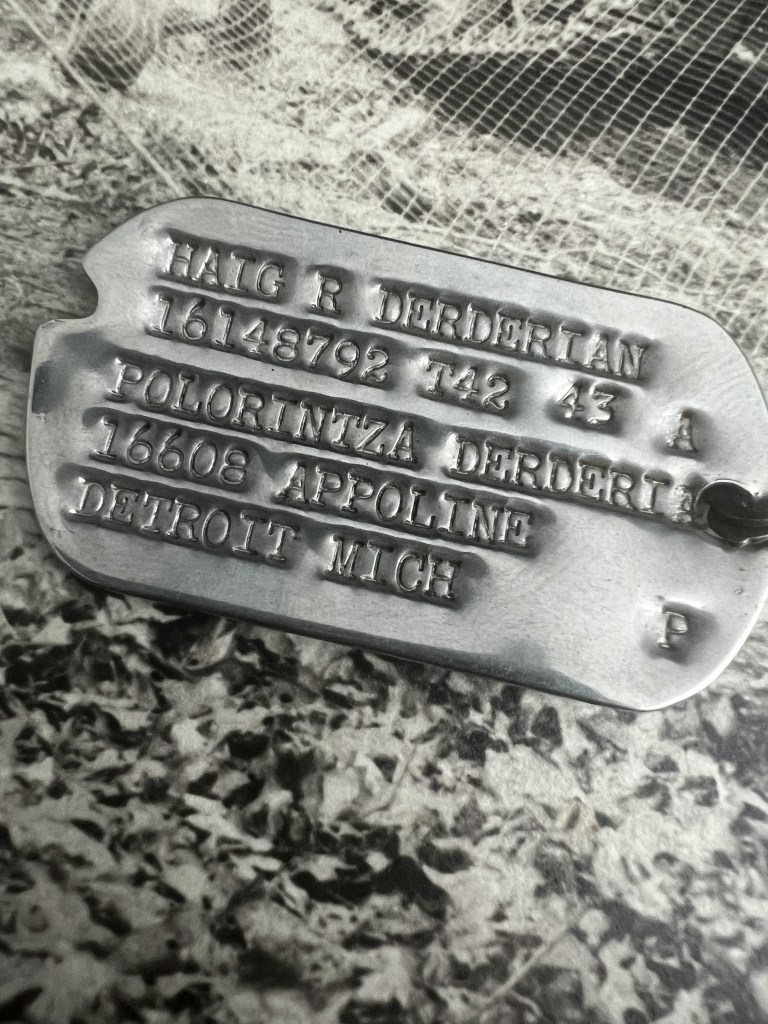
Information from the Battlefield Hospital Admissions Card from the Office of the US Surgeon General only reports that Haig was treated for a laceration on his arm and released that day. He didn’t even spend the night at the hospital barracks. The hospital report is particularly unremarkable for the injury and shocking experience that Haig endured that day.
He was sent back to his battalion where — for the next month until the Germans surrendered on May 8th — Haig and his division would encounter small retreating enemy fire from the Germans, take prisoners of war, rebuild bridges, and sweep for mines. Haig never sustained another injury in the war and he would be honorably discharged from the Army Oct. 30th, 1945 after serving three years and four days.
Not too long after that, Haig was advised that he would receive the Purple Heart for his bravery and injuries that he sustained on April 17, 1945. He also had received the U.S. Army’s European Theater Ribbon medal for good conduct, and a Certificate of Merit for his outstanding contribution to the U.S. Army in its battle of Herrlisheim, France, against the Germans that had occurred Jan. 8-19, 1945.
Epilogue
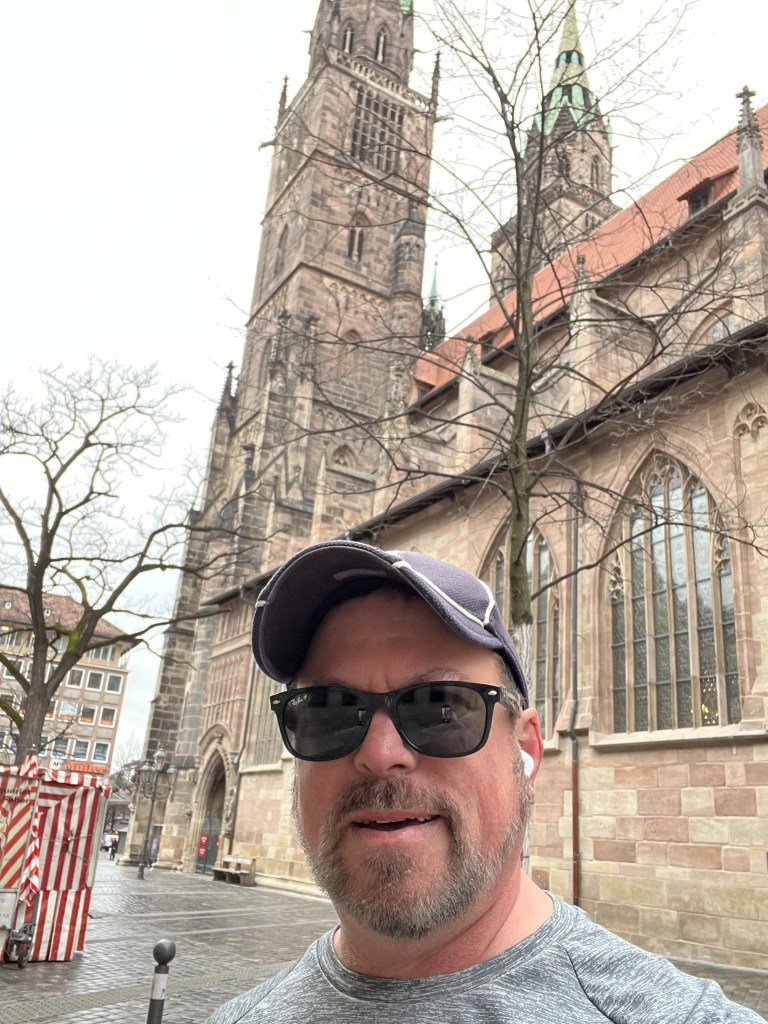
Each spring since 2016, I’ve traveled to Nuremberg, Germany, on business to the world’s largest electronic trade fair, embedded world. Exhibiting at the show are the world’s largest technology companies showing off their latest computer hardware and software used in the automotive, industrial, medical, and smart technology industries. There are numerous companies from the U.S. that exhibit and attend, as well as companies from Taiwan, Canada, Japan, and many from Germany. It is a world united by technology, business, and great friendships. Past wars are not discussed and they are all but forgotten.
Every year for embedded world, I have stayed at the Marriott Hotel Le Meridien Grand hotel in the Altstadt (old town) section of Nuremberg. The irony is that the hotel is located just 35 miles away from where Haig got injured in the war in 1945 to earn his Purple Heart and where he and his troops battled Nazi soldiers in a 100-mile radius almost 80 years ago.
This year in April when I travel to Nuremberg again for embedded world, I’m taking several days to retrace the route that Haig and his 714th Tank Battalion took in their battles against the Germans.
I’m not sure what I’ll encounter or what stories will unfold. It will be an adventure. But one thing for sure — I’ll bring a piece of Haig with me and hold on to his Purple Heart medal every step of the way.